
TIMEPIX@school
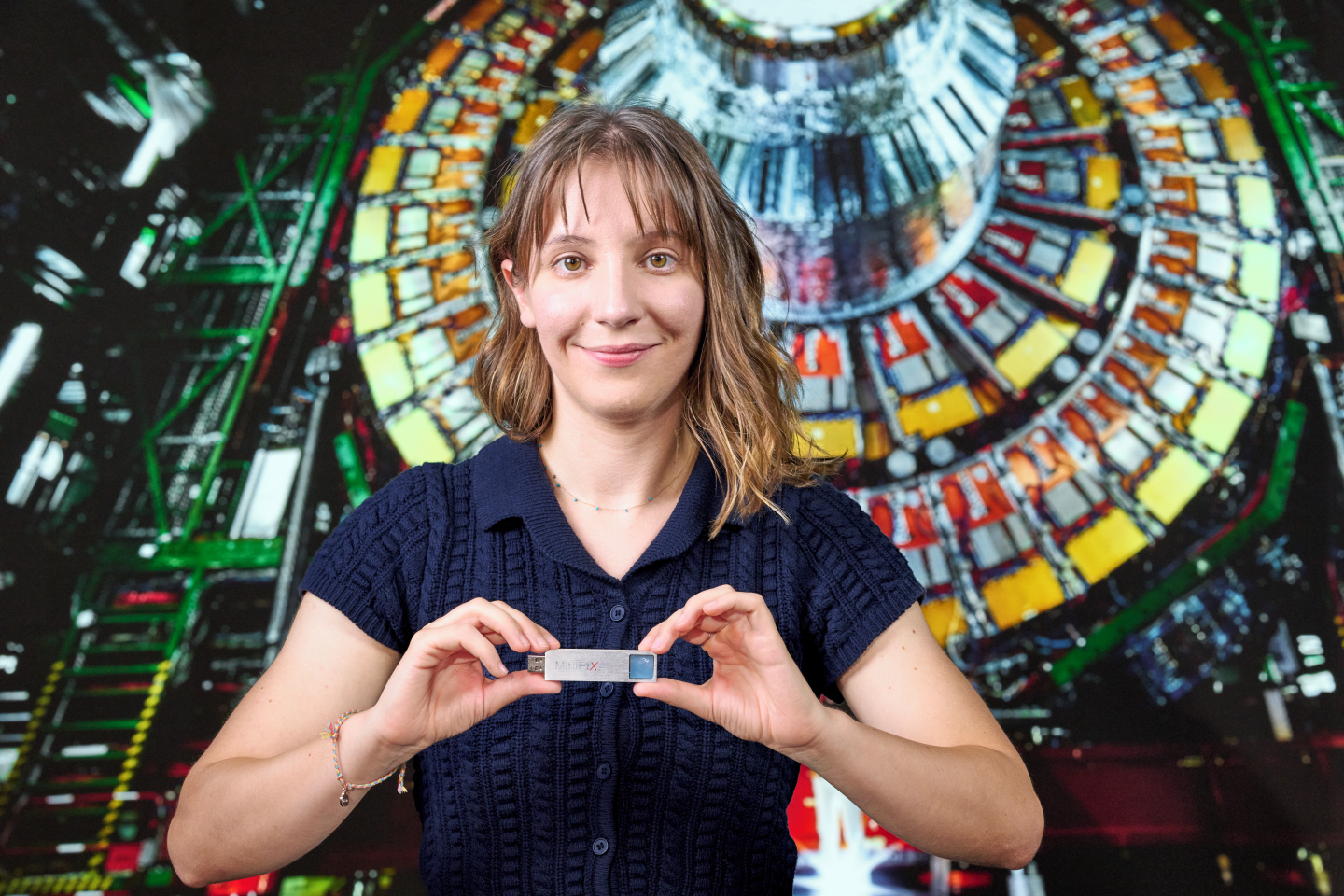
Anna, TIMEPIX@school pilot high school user, now works in Data Analysis.
“To have access to such exciting technology which enabled us to be part of genuinely impactful experiments was so empowering. Aside from the excitement of learning concepts that went well beyond the curriculum, it also gave myself and others confidence in my ability to learn, research, and share ideas that I would certainly not have otherwise had. To have that confidence built at that age stood me in great stead as I was making decisions about my future. Not only was I inspired by all of the fascinating science that I learned through the experiments that we were able to conduct with TimePix, but I felt as though my peers and I could really, meaningfully contribute. It was a completely unique experience and I am very grateful.”
Empowering tomorrow’s scientists
TIMEPIX@school is a pioneering initiative which brings detector technology developed at CERN into schools, giving students the opportunity to explore the invisible world of radiation that is all around them.
The project is built around the Timepix chip, a silicon chip developed within the CERN Medipix2 Collaboration. Integrated into a compact device that connects to a computer via USB and works with user-friendly software, this technology allows students to visualise ionising radiation in real time. They can observe tracks from background radiation, environmental sources, and cosmic rays, distinguish between different types of particles, and analyse how they interact with matter on an ordinary computer. This makes it accessible to schools of all types, including those without dedicated science labs.
Timepix chips find exciting applications across high-energy physics, medicine, aerospace, and art. By allowing students to experiment with this technology, TIMEPIX@school connects classroom physics with everyday life, highlighting how science contributes to real-world societal challenges.
At the heart of the initiative is a commitment to broadening participation in STEM. Particular emphasis will be placed on reaching schools in underserved and underrepresented communities, and engaging female students.
By providing hands-on physics experiences, the project aims to spark scientific curiosity among young people. Early pilot schools have already reported significant increases in student engagement and enthusiasm for science subjects. Many students describe the experience as their first encounter with real scientific data – and one that makes them feel part of the scientific community.
By placing real research tools in the hands of the next generation, the project hopes to inspire future scientists and ensure that access to meaningful science education is available to all. The current call for proposals is open until the 30 June.