
Meet Mahmoud from Egypt: completing a PhD at CERN through the non-Member State PhD Studentship
Mahmoud is a PhD student at CERN and the University of Bologna, whose research focuses on experimental particle physics as part of the Future Circular Collider (FCC) project. We chatted with him recently to catch up on how it is all going!
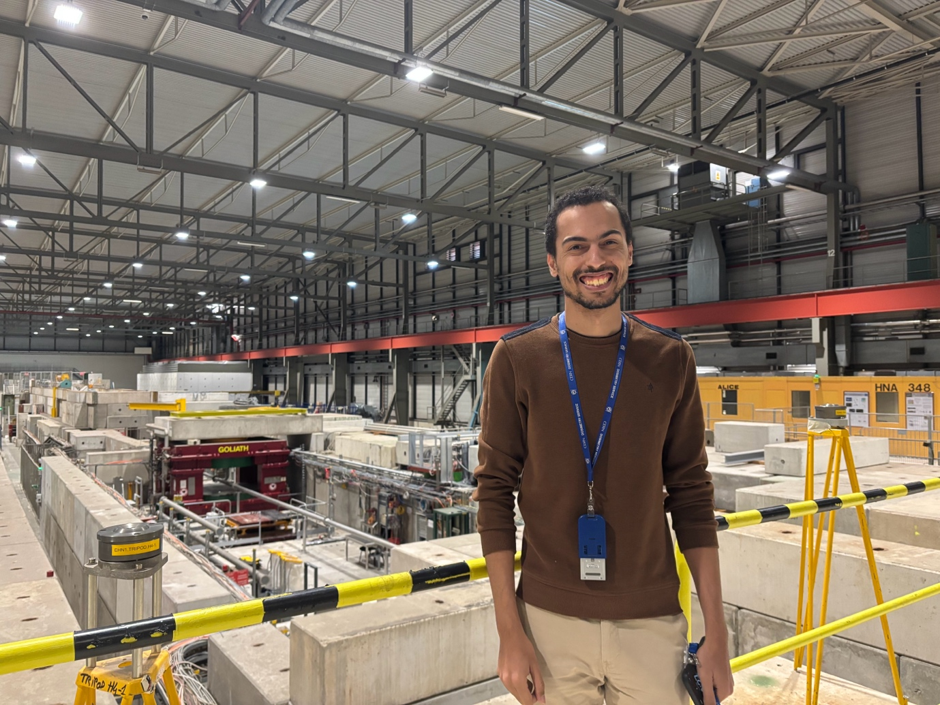
What is it like doing a PhD at CERN?
Doing a PhD is one thing and doing it at CERN is something else.
Doing a PhD, performing research, is very interesting to me. You work every day on a piece of science that nobody has ever worked on before.
At CERN it is very special, because I go around meeting people who are leaders in their field. Maybe in the corridor I meet someone who has created the software I have been working on for years, or perhaps even a Nobel Prize winner. The experience here is great. CERN is like nowhere else on earth.
Since I was a kid, I dreamt of being an engineer, but I never imagined designing the largest machine to ever be built by humans – the FCC.
What does your research focus on?
My research focuses on the design, simulation and development of the muon detection system for the Future Circular Collider (FCC-ee).
The first part of my work is dedicated to the simulation and optimisation of the IDEA detector muon system. Using advanced simulation tools, we study how the detector will perform in the challenging environment of a future collider. We optimise its geometry and evaluate its ability to identify and reconstruct particles produced in high-energy collisions, with a particular focus on improving the reconstruction of long-lived particles (LLPs). These are hypothetical particles that, unlike most particles produced in collisions, can travel a measurable distance inside the detector before decaying, leaving unique signatures that we can study.
The second part of my research focuses on the development of the micro-RWELL prototype gaseous detector. The ultimate goal is to use this technology in the FCC-ee muon system. By combining high-performance detector technologies with optimised detector design, we aim to improve our ability to study new physics phenomena, including possible long-lived particles. As part of my PhD, we test different gaseous detector technologies and configurations using particle beams, allowing us to understand their performance under realistic experimental conditions and identify the best solutions for future collider experiments.
I don’t have a background in particle physics – can you explain that to me in simple terms?
Imagine we are building a racetrack, but instead of racing cars, we are racing really tiny particles which are the main constituents of the universe. We are racing them at high speed: close to the speed of light. We collide them at a specific point, where the crash happens, creating a very energetic interaction where new particles can appear.
My research comes in at this point. I am designing a special detector, a bit like a special camera, to see what happens during the collision. All the tiny particles appear instantly after the collision – except for one, the hypothetical long-lived particle (LLP). This particle is kind of shy; it doesn’t show itself instantly but rather, travels away from the collision point and then decays. The purpose of my PhD is to design a detector that helps us see these particles better.
And why is that important?
The importance of the PhD is to try to unveil some secrets of the universe. The universe still has many aspects that we don’t know anything about, like dark matter and what it is made of, so perhaps the long-lived particle will have information related to this.
Parting words:
I am very thankful to the CERN & Society Foundation for giving me the opportunity to work here at CERN. It’s something truly meaningful to me, and something I have never forgotten. It actually happened twice in my life: during my Bachelor’s degree, I came as a non-Member State Summer Student, and that experience became a turning point in my career, guiding me from applied engineering to fundamental physics. Now, I have been given this opportunity again to go very deep with a PhD, and I am very grateful for that.
The non-Member State PhD Studentship connects CERN with the world, fostering a new global research community of talented minds exploring their curiosity right at the forefront of cutting-edge fundamental research. It is supported through external donations.